
 English
 Español
 Pусский
 Français
 Deutsch
 العربية
 Türk dili
 Indonesia
 Tiếng Việt
opções de capacidade de petroleiros
Oil tankers are integral to the global movement of liquid energy and refined products, with capacity options tailored to operational constraints, trade routes, and market demands, measured primarily in deadweight tonnage (DWT) to reflect total payload including cargo, fuel, and ballast water. These options are categorized by size, each serving distinct maritime segments.The smallest operational class is regional short-sea tankers, ranging from 10,000 to 50,000 DWT. Designed for coastal or cross-basin trips (e.g., within the Mediterranean or between U.S. East Coast ports), these vessels feature shallow drafts that allow access to small, shallow ports unsuitable for larger ships. They primarily transport refined petroleum products like gasoline and diesel, or light crude oil, offering flexibility for frequent port calls and adjustable cargo volumes aligned with local demand.Mid-range tankers, falling between 50,000 and 80,000 DWT, strike a balance between flexibility and efficiency. Ideal for cross-regional routes such as Europe to West Africa or Southeast Asia’s inter-island trade, their mid-sized hulls accommodate segregated cargo tanks, enabling simultaneous transport of multiple product grades while maintaining the ability to call at most major regional ports. This class is highly versatile, adapting to both refined product and medium crude cargoes, making it a staple for intermediate energy trade flows.At the upper end, very large crude carriers (VLCCs) span 200,000 to 320,000 DWT, the backbone of long-haul crude oil trade. Capable of carrying over 2 million barrels of crude oil, VLCCs deliver exceptional economies of scale, reducing per-barrel transportation costs for transoceanic routes like Middle East to East Asia or West Africa to Europe. However, their deep draft (up to 20 meters) restricts them to deepwater ports, requiring dedicated deep-water terminals for loading and unloading, limiting their use to major trade hubs. Ultra large crude carriers (ULCCs), exceeding 320,000 DWT, offer even lower unit costs but are less common today due to port infrastructure limitations and regulatory priorities for more flexible, smaller vessels in some segments.The selection of tanker capacity hinges on three core factors: route-specific port depth, trade volume per voyage, and cargo type. Smaller vessels dominate short, fragmented trades, while VLCCs and ULCCs support bulk long-haul crude movements, creating a tiered system that underpins the reliability and cost-effectiveness of global energy supply chains. (Word count: 497)
Produto
Categoria:
-
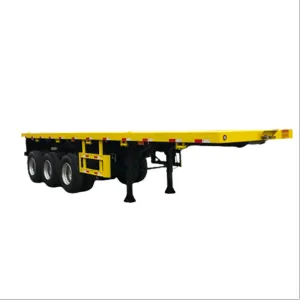
Mesa de contêiner de 3 eixos
Sua classificação: Mesa de contêinerVistas: 695Número:Tempo de liberação: 2026-05-29 15:59:26O contêiner plano de 3 eixos da Junchi Heavy Industry é o modelo padrão de transporte de contêineres para contêineres de peso normal. Estrutura simples e baixo custo de manutenção fazem dele o carro-chefe de portos, depósitos e empresas de logística.
Notícias
Categoria:
Nenhum resultado de pesquisa!
Caso
Categoria:
Nenhum resultado de pesquisa!
Vídeo
Categoria:
Nenhum resultado de pesquisa!
Download
Categoria:
Nenhum resultado de pesquisa!
Recrutamento
Categoria:
Nenhum resultado de pesquisa!
Produtos recomendados
-
NEWS
Mesa de contêiner de 3 eixos
Saiba mais



 Telefone